Narva · Estonia
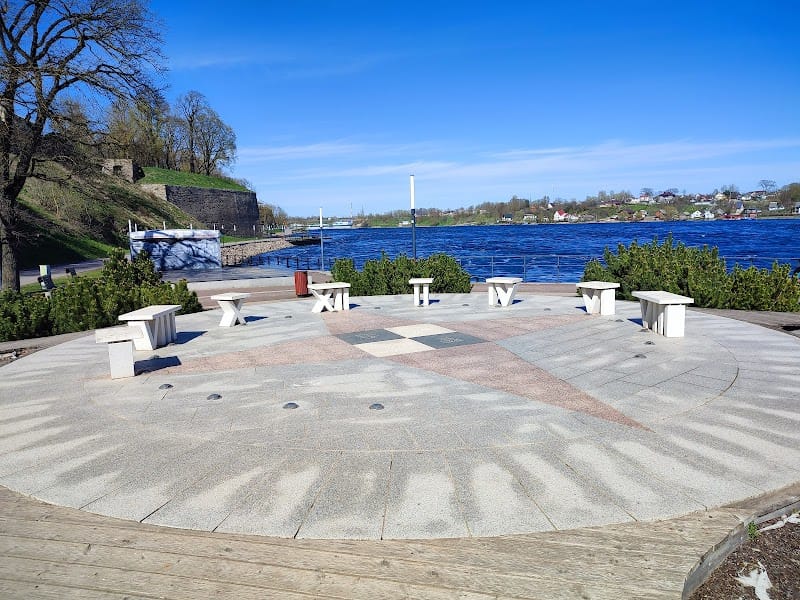
Sun Square
📍 20609 Narva, Estonia
Photos
Saint Petersburg, formerly known as Petrograd and later Leningrad, is the second-largest city in Russia, after Moscow, the nation's capital. Situated on the Neva River at the head of the Gulf of Finland on the Baltic Sea, its area of 1,439 square kilometers (556 sq mi) renders it the smallest administrative division of Russia by area. The city had a population of 5,601,911 residents as of 2021, with more than 6.4 million people living in the metropolitan area. Saint Petersburg is the fourth-most populous city in Europe, the most populous city on the Baltic Sea, and the world's northernmost city of more than 1 million residents. As the former capital of the Russian Empire, and a historically strategic Baltic port, it is governed as a federal city. The city was founded by Tsar Peter the Great on 27 May 1703 on the site of a captured Swedish fortress, and was named after the apostle Saint Peter. In Russia, Saint Petersburg is historically and culturally associated with the birth of the Russian Empire and Russia's entry into modern history as a European great power. It served as a capital of the Tsardom of Russia, and the subsequent Russian Empire, from 1712 to 1918 (being replaced by Moscow for a short period between 1728 and 1730). After the October Revolution in 1917, the Bolsheviks moved their government to Moscow. The city was renamed Leningrad after Lenin's death in 1924. It was the site of the siege of Leningrad during World War II, the most lethal siege in history. In June 1991, only a few months before the Belovezha Accords and the dissolution of the Soviet Union, voters in a city-wide referendum supported restoring the city's original name. As Russia's cultural centre, Saint Petersburg received over 15 million tourists in 2018. It is considered an important economic, scientific, and tourism centre of Russia and Europe.
- 1 Saint Petersburg is the fourth-most populous city in Europe, the most populous city on the Baltic Sea, and the world's northernmost city of more than 1 million residents.
- 2 The city was founded by Tsar Peter the Great on 27 May 1703 on the site of a captured Swedish fortress, and was named after the apostle Saint Peter.
- 3 It was the site of the siege of Leningrad during World War II, the most lethal siege in history.
- 4 In modern times, the city has been nicknamed "the Northern Capital of Russia" and is home to notable federal government bodies such as the Constitutional Court of Russia and the Heraldic Council of the President of the Russian Federation.
- 5 It is also home to the National Library of Russia and a planned location for the Supreme Court of Russia, as well as home to the headquarters of the Russian Navy, and the Leningrad Military District of the Russian Armed Forces.
Comments
No comments yet — be the first to share your visit (in the app).
Want to leave a review? Comments are written from inside the app — download Baltic Traveler to share your visit.